Skip to the accounts
History of Psychoanalysis

History of Psychoanalysis / Relationships & Practice

The formative years18801945

Boundaries:
Analytic Intimacy

Love, loyalty, and the boundaries of psychoanalysis

Follow the questions raised by personal warmth, self-disclosure, overlapping relationships, confidentiality, and institutional power in psychoanalysis.

Letters · lives · institutions · 225 historical accounts · 4 later cases · 6 ways to exploreRead the accounts

A history of overlapping roles

Personal relationships.
Professional consequences.

Psychoanalysis developed within networks in which patients became colleagues, analysts treated relatives and friends, and private loyalties entered professional decisions. Letters and recollections make these connections visible in the lives behind the theories. [11]

This collection brings individual episodes together with broader practices. Follow the relationships, the decisions they shaped, and the accounts left by the people involved.

Choose a thread

Six ways into the history

A relationship can belong to more than one theme.

People, practices & evidence

The accounts

Open an account for its history, connections, and sources.

225 historical accounts

The 225 historical accounts follow events through 1945. The 4 separately labeled later cases are also searchable; choose “After 1945” to see just those. Later memoirs and research can document earlier events. Event dates determine the filters; undated reports appear under “All periods.”

Later history · 1949–1988

Later cases: intimacy and authority

The main collection follows 1880–1945. These later episodes are searchable alongside the earlier accounts, but they're clearly marked and don't change the historical collection's dates or totals. Follow the relationships in Genealogy, too.

1949–1953 · He analyzed the son of the woman he had made famous

Jacques Lacan · Didier Anzieu · Marguerite Pantaine (Aimée)

Didier Anzieu began an analysis with Lacan in 1949. He didn't initially know that his analyst had studied his mother, Marguerite Pantaine, for the 1932 thesis that called her Aimée. He found out through his mother and read the thesis while still in treatment. The analysis ended in July 1953.

When confronted, Lacan said he had eventually put the identities together. Roudinesco interprets his explanation as motivated avoidance; Didier rejected some of her larger psychoanalytic interpretations. Their disagreement about what Lacan knew doesn't erase the overlap: he had made the mother's psychiatric history public and then analyzed her son without disclosing the connection.

Allouch, 1994; Roudinesco, 1997.

1951–1963 · Sessions that could end when Lacan decided

Jacques Lacan · Serge Leclaire · Wladimir Granoff

Lacan ended analytic sessions at variable lengths, sometimes after ten or twenty minutes rather than the conventional fifty. His supporters treated the timing of an interpretation as part of the method. His critics saw an analyst exercising one-sided control over the patient’s time. The brevity also enabled him to take on more analysands, including candidates who depended on his recognition for training.

The International Psychoanalytical Association's investigations of the French group repeatedly returned to session length and training standards. In 1963, the negotiations failed to secure recognition for Lacan as a training analyst. The conflict concerned professional authority, money, and the patient's control over time—not merely a disagreement about technique.

Roudinesco, 1997.

1970s · Catherine Millot was both his analysand and his lover

Jacques Lacan · Catherine Millot

Catherine Millot began analysis with Lacan in the early 1970s and became his intimate partner. She traveled with him, shared his daily life, and remained in analysis throughout their sexual relationship. In the final chapter of Life with Lacan, she states: “In all those years, my analysis with Lacan had continued.”

Millot remembers the attachment with warmth and credits her analysis with profound personal change. She also describes the difficulty of knowing when such an analysis could be finished. Her account makes both facts visible: she experienced the treatment as valuable, and Lacan continued analyzing a woman with whom he was sexually involved.

Millot, 2018; Roudinesco, 1997.

1951–1966 · Winnicott and Khan: when analysis became patronage

Donald W. Winnicott · Masud Khan

Masud Khan began analysis with D. W. Winnicott in 1951. Winnicott supervised Khan’s first child-analysis case and later supported his applications to become a training analyst. The British Society rejected three applications before accepting Khan in 1959. Meanwhile, Khan collaborated with Winnicott on a review of Fairbairn and helped prepare collections of Winnicott’s papers. Treatment, professional advancement, and intellectual collaboration came together while the analysis was still underway.

Hopkins argues that these overlapping roles made it harder to address aggression and dependency in the analysis. That's her retrospective clinical interpretation. The documented relationships show something more immediate: Winnicott supported his patient's professional standing, while his own publications benefited from Khan's editorial work.

Khan later committed serious boundary violations involving his own patients. The British Psychoanalytical Society expelled him in 1988, long after Winnicott's death. Sandler examines the Society's response to conduct by an analyst it had authorized to train others. Those later events don't establish what Winnicott knew or condoned. They make the earlier overlap between treatment and professional authority an important part of this history.

Hopkins, 1998 · 5–47; Sandler, 2004 · 27–42; Rodman, 2003.

Practice and principle

The rules and the conflicts within them

The historical record includes arguments about limits made by the participants themselves. The distance between a stated principle and an actual relationship was already a subject of dispute.

1915

Love in treatment

In Observations on Transference-Love, Freud argued that an analyst should recognize a patient’s love while declining to turn treatment into a sexual relationship. His technical writing addressed the analyst’s own temptation and responsibility. [53]

Explore love & treatment ↗
1912–1922

The patient’s interests

In the Kann correspondence, Freud stated that his patient’s interests came before his friendship with Jones. In Riviere’s case, he criticized Jones’s premature friendship as a technical error. These exchanges show contemporaries recognizing conflicts they could also help create. [11]

Read the Kann network ↗
1926

Whose purpose did analysis serve?

Helene Deutsch’s private letter to Felix Deutsch questioned the relation between therapeutic claims and scientific inquiry. Her criticism records a participant’s concern about what was being promised to patients and whose interests treatment served. [11]

Read Deutsch’s criticism ↗

The archival record

In their own words

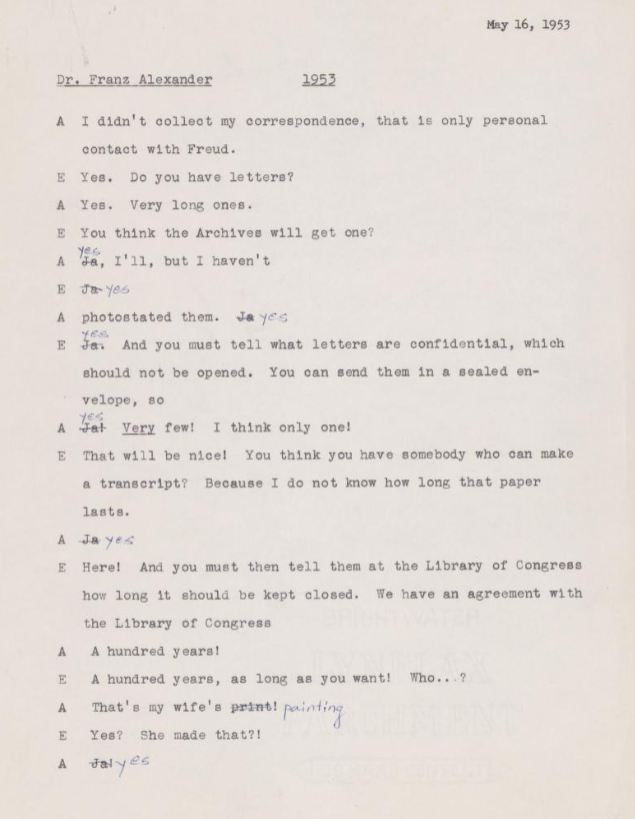
Interviews preserve a participant’s recollection as well as the interviewer’s questions.

The links open public archival records. Riviere’s item is a transcript; the Severn and Jackson records contain audio. Accounts identify when an interview or memoir supplies retrospective testimony.

Later clinical theory · 1989–2003

Later clinical perspectives on gender and desire

Gender and the analytic encounter

Nancy Kulish’s 1989 paper drew on conversations with seventeen senior female analysts about how an analyst’s gender enters treatment. Most participants thought gender affected the sequence in which material emerged, the fantasies attached to the analyst, and the interpretation of those fantasies. Their accounts included both maternal and paternal transferences to women analysts, with differences in how sustained or accessible each became.

Kulish also examined erotic transference and the inhibitions surrounding it. Some interviewees described patients’ sexual wishes as difficult to express; others emphasized the analyst’s discomfort, expectations, or reluctance to recognize them. A woman analyst could be experienced as desirable, maternal, paternal, or rivalrous at different moments. Kulish treated the analyst’s gender as part of a perceptual setting through which patient and analyst organized the relationship, shaping what’s heard and how it’s interpreted.

Kulish, 1989.

Maternal erotic transference and countertransference

Judith Welles and Harriet Kimble Wrye placed the early mother–child relationship at the center of their account of erotic transference and countertransference. In their 1991 paper and their 1994 book, The Narration of Desire, maternal erotism includes tenderness, bodily longing, pleasure, disgust, aggression, and sadomasochistic fantasy. These feelings arise from the earliest sensual contacts between mother and infant and can acquire expression in fantasies about an analyst’s body, closeness, or care.

Their model gives preoedipal and pregenital experience an erotic life of its own. They describe early maternal erotism as contributing to later genital sexuality, while its reappearance in treatment can move between maternal closeness and the desires and rivalries of the oedipal triangle. Maternal erotic transference becomes a way of encountering the patient’s early bodily experience within an adult analytic relationship.

The analyst’s response forms part of this process. Welles and Wrye describe withdrawal, disgust, excessive solicitude, and emotional deadness as possible responses to feelings that are difficult to acknowledge. Their technical argument centers on the analyst’s capacity to experience, contain, and interpret this material. When an analyst recognizes erotic and aggressive feelings in herself or himself, those feelings become available for reflection and analytic work.

They also examine the wish to rescue or radically remake a patient. An unrecognized wish can take the form of seductive caretaking or sexual acting out. Their account links the gradual transformation of desire to the analyst’s ability to sustain the relationship, recognize countertransference, and keep the work open.

Welles & Wrye, 1991; Wrye & Welles, 1994.

Sexual rivalry and the wish to nurture

Nancy Kulish and Deanna Holtzman’s 2003 paper examined what happens when an analyst understands a woman’s separation distress chiefly through dependency and maternal care. Their two clinical accounts show sexual wishes, rivalry, and competition entering relationships organized around the analyst’s wish to be a nurturing maternal figure.

For Kulish and Holtzman, separation belongs within the girl’s triangular situation as well as her early relation to her mother. The mother can remain a source of care while becoming a rival in the child’s desire for her father. Sexual assertion can then raise fears about losing affection, closeness, or protection.

In the clinical accounts, new love affairs and interruptions in analysis brought these conflicts into view. An analyst’s attachment to a nurturing role could help sustain a dependent relationship and obscure the patient’s desire for a life beyond it. Kulish and Holtzman connected changes in developmental theory with changes in interpretation: recognizing a patient’s sexual wishes and competitiveness could make her separation struggles more intelligible.

Female development and the Persephone model

Kulish & Holtzman, 2003.

The professional world of psychoanalysis

Letters, interviews, and diaries bring this professional world into view, often through recollections published decades after the events.

1931–1942

The circle that built the Institute

Five early clinicians and the founding patron had been Alexander’s patients. His former Berlin teacher became his deputy; former analysands became salaried colleagues. Family, university, and philanthropic connections joined the clinical circle to the trustees, advisers, and consultants. [154] [115]

Explore the founding group and its connections ↗
1931–1945

Two institutions, overlapping authority

The Society preceded the Institute and elected its own officers. By 1935 its president was Menninger, its vice-president French, and its secretary-treasurer McLean. Stern, the Institute’s founding patron and Alexander’s former patient, belonged as a non-therapeutic member. Scientific meetings and clinical relationships brought the two organizations together. [158] [119]

Explore the Society and the Institute ↗
1933

Treatment, training, and research

The Institute’s contemporary report listed ten training analyses alongside twenty-six therapeutic analyses. Its small teaching group included Alexander, Horney, French, McLean, Bacon, and Saul. Courses also reached medical practitioners, social workers, and teachers. [97]

Read about clinical records in Chicago ↗
1935

Love, work, and public advice

Ruth De Young’s report of Horney’s Seattle address put psychoanalytic ideas before women seeking professional and economic independence. Horney challenged both the defense of male superiority and women’s overinvestment in love and marriage. [35]

Read Horney’s relationship history ↗
A later professional history · 1993

Women as teachers and institutional leaders

Helen Beiser’s history describes women’s work in Chicago’s supervision, research, and administration. Horney, Bacon, McLean, Benedek, Fleming, and others helped form the professional setting in which treatment and training took place. [15]

Read about women and staff recruitment ↗
Appointments, 1910–1920 · reconstruction published 2018

Inside Freud’s appointment books

Ulrike May’s reconstruction adds dates, frequency, and recorded hours to the history of Freud’s practice. Correspondence and memoirs bring the calendars into a wider world of family ties, friendships, and professional instruction, including Anna Freud’s analysis and Jan van Emden’s analytic holiday walks. [128]

Read the holiday analysis account ↗
1924–1929

Membership, movement between societies, and lay analysis

The correspondence distinguishes Society membership, Institute membership, and work at a clinic. In September 1924 Jones reported that the London Institute would share its membership with the Society’s full medical members for political reasons. In the 1925 Caroline Newton dispute, Freud distinguished the rights enjoyed in another group from formal transfer into its membership; the exchange also addressed the rules governing election to a foreign group. In September 1926 Jones defended the need for trained lay analysts, and in October 1929 he reported rules admitting all lay members to Clinic work, with full Society members eligible for permanent staff and candidates serving as assistants. Professional recognition operated through particular bodies, rules, and changes over time. [68]

Explore the British Society and its clinical circle ↗
1933–1935 · letters published in 2002

Letters between sessions

H.D. wrote to Bryher about dreams, interpretations, gifts, fees, and the people Freud discussed with her. Bryher arranged and financed treatment while supporting analytic training and publishing. Their correspondence follows analysis into a shared household and a wider circle of friends, showing how personal attachment, money, and professional opportunity met in everyday decisions. [74]

Read H.D. and Bryher’s correspondence around analysis ↗
Early twentieth century · later historical interpretation

Queer lives inside psychoanalysis

Shared households, same-sex attachments, patronage, and analytic work repeatedly met in the same networks. Their intersection can illuminate the distribution of care and authority without making a queer relationship itself a boundary violation. The Genealogy feature follows these lives alongside later challenges to psychoanalytic theories of sexuality. [136]

Explore queer intersections in history and theory ↗

Books, letters & research

Sources & further reading

How to read the evidence

Letters, diaries, and recollections. Letters and diaries preserve contemporary statements. Memoirs and interviews bring participants’ later recollections, while biographies and historical studies connect events across records. Institutional histories follow complaints and professional decisions.

Follow the sources. Each account identifies the people, events, and sources behind it. The works cited link to the full bibliography.

Explore the connections. Follow a person into the analytic genealogy, open a related account, or use the themes to trace relationships across the collection. Each account has a permanent link for citation and return.

References are alphabetized by author, with books and papers alongside archives, institutional records, and newspapers. Substantive historical archives and collections retain their access links.

The full bibliography 197 resources
  1. Books & chapters

    Allouch, J. (1994). Marguerite, ou l’Aimée de Lacan (2nd rev. & expanded ed.; postface by D. Anzieu). EPEL.

  2. Journals & periodicals

    Amouroux, R. (2010). Marie Bonaparte, her first two patients and the literary world. The International Journal of Psychoanalysis, 91(4), 879–894.

  3. Reference & web resources

    Anaïs Nin Foundation. (n.d.). The legacy of Anaïs Nin: A literary pioneer. https://anaisninfoundation.org/bio

  4. Books & chapters

    Andreas-Salomé, L. (1987). The Freud journal (S. A. Leavy, Trans.; M.-K. Wilmers, Intro.). Quartet Books.

  5. Books & chapters

    Andreas-Salomé, L., & Freud, A. (2003). … als käm ich heim zu Vater und Schwester: Briefwechsel 1919–1937 (D. A. Rothe & I. Weber, Eds.; 2nd rev. ed., Vol. 1). Wallstein Verlag. (Original work published 2001)

  6. Books & chapters

    Andreas-Salomé, L., & Freud, A. (2003). … als käm ich heim zu Vater und Schwester: Briefwechsel 1919–1937 (D. A. Rothe & I. Weber, Eds.; 2nd rev. ed., Vol. 1). Wallstein Verlag. (Original work published 2001)

  7. Books & chapters

    Andreas-Salomé, L., & Freud, A. (2003). … als käm ich heim zu Vater und Schwester: Briefwechsel 1919–1937 (D. A. Rothe & I. Weber, Eds.; 2nd rev. ed., Vol. 2). Wallstein Verlag. (Original work published 2001)

  8. Books & chapters

    Andreas-Salomé, L., & Freud, A. (2003). … als käm ich heim zu Vater und Schwester: Briefwechsel 1919–1937 (D. A. Rothe & I. Weber, Eds.; 2nd rev. ed., Vol. 2). Wallstein Verlag. (Original work published 2001)

  9. Reference & web resources

    Andreas Schweizer (n.d.). Club history: Emerging into a new century. https://www.psychologyclub.ch/en/club-history/club-history

  10. Reference & web resources

    Andreas Schweizer (n.d.). Toni Wolff 1888–1953. https://www.psychologyclub.ch/en/club-history/toni-wolff

  11. Books & chapters

    Appignanesi, L., & Forrester, J. (1992). Freud’s women. Basic Books.

  12. Books & chapters

    Appignanesi, L., & Forrester, J. (1992). Freud’s women. Basic Books.

  13. Reference & web resources

    Bates, G. (2024, March 8). Forgotten women in psychiatry: Jessie Murray (1867–1920). Royal College of Psychiatrists. https://www.rcpsych.ac.uk/news-and-features/blogs/detail/history-archives-and-library-blog/2024/03/08/forgotten-women-in-psychiatry--jessie-murray-(1867-1920)

  14. Journals & periodicals

    Beiser, H. R. (1981). Child analysis in Chicago. The Annual of Psychoanalysis, 9, 3–7.

  15. Journals & periodicals

    Beiser, H. R. (1993). Women in Chicago psychoanalysis. The American Psychoanalyst, 27(1), 23.

  16. Journals & periodicals

    Bentinck van Schoonheten, A. (2015). Psychoanalytische techniek aan het begin van de twintigste eeuw [Psychoanalytic technique at the beginning of the twentieth century]. Tijdschrift voor Psychoanalyse, 21(2), 107–117.

  17. Books & chapters

    Berman, E. (2004). Impossible training: A relational view of psychoanalytic education. The Analytic Press.

  18. Books & chapters

    Bertin, C. (1982). Marie Bonaparte: A life. Harcourt Brace Jovanovich.

  19. Journals & periodicals

    Blatow, A. (2016). »Ich fühle irgendwie die Verantwortung für die Gesamtarbeit weit mehr auf mir lasten als sonst.« Annie Reich (1902, geb. Annie Pink, †1971 Annie Reich-Rubinstein) – eine biografische Skizze. Freie Assoziation, 19(1), 11–15.

  20. Journals & periodicals

    Blechner, M. J. (2014). Dissociation among psychoanalysts about sexual boundary violations. Contemporary Psychoanalysis, 50(1–2), 23–33.

  21. Reference & web resources

    Bloch, M. (2023). Stephen Tomlin: A biographical sketch. https://philipmould.com/news/316-stephen-tomlin-a-biographical-sketch-by-michael-bloch/

  22. Archives & interviews

    Bonaparte, M. (1930, March 25). [Letter to Sigmund Freud]. In Correspondance entre Marie Bonaparte et Sigmund Freud (1925–1939): Extraits. Fondation Napoléon. (Excerpt from the correspondence edition published by Flammarion in 2022)

    View source
  23. Books & chapters

    Borch-Jacobsen, M. (2021). Freud’s patients: A book of lives (A. Brown, Trans.). Reaktion Books.

  24. Journals & periodicals

    Brunswick, R. M. (1928). A supplement to Freud’s “History of an infantile neurosis.” The International Journal of Psycho-Analysis, 9, 439–476.

  25. Newspapers

    Bulliet, C. J. (1936, January 25). Anita Venier Alexander (Artists of Chicago, No. 49). Chicago Daily News. Transcribed by the Illinois Historical Art Project.

  26. Journals & periodicals

    Burlingham, D. T. (1935). Child analysis and the mother. The Psychoanalytic Quarterly, 4(1), 69–92. (Original work published 1932)

  27. Books & chapters

    Burlingham, M. J. (1989). The last Tiffany: A biography of Dorothy Tiffany Burlingham. Atheneum.

  28. Journals & periodicals

    Burlingham, M. J. (1991). The relationship of Anna Freud and Dorothy Burlingham. Journal of the American Academy of Psychoanalysis, 19(4), 612–619.

  29. Books & chapters

    Carotenuto, A. (1982). A secret symmetry: Sabina Spielrein between Jung and Freud (A. Pomerans, J. Shepley, & K. Winston, Trans.). Pantheon Books.

  30. Institutional reports

    Chicago Institute for Psychoanalysis. (n.d.). Proceedings of the Third Psychotherapy Council, Chicago, October 18 and 19, 1946.

  31. Institutional reports

    Chicago Psycho-Analytic Society. (1936). Bulletin of the International Psycho-Analytical Association, 17, 262–263.

  32. Reference & web resources

    Citizens’ Committee for Children of New York (2004). 60th anniversary annual report.

  33. Reference & web resources

    Deutsche Psychoanalytische Gesellschaft (n.d.). Carl Müller-Braunschweig. https://dpg-psa.de/Carl_M%C3%BCller-Braunschweig.html

  34. Books & chapters

    Deutsch, H. (1973). Confrontations with myself: An epilogue. W. W. Norton & Company.

  35. Newspapers

    De Young, R. (1935, July 18). Tells women they put love above success: Psychologist is speaker at business meeting. Chicago Daily Tribune, p. 19.

  36. Reference & web resources

    DFF – Deutsches Filminstitut & Filmmuseum (n.d.). Abwege (1928): Credits and film information. https://www.filmportal.de/en/movie/abwege_ea43d4a697ee5006e03053d50b37753d

  37. Journals & periodicals

    Drescher, J. (2013). [Review of the book Private practices: Harry Stack Sullivan, the science of homosexuality, and American liberalism, by N. Wake]. Journal of Gay & Lesbian Mental Health, 17(2), 247–251.

  38. Books & chapters

    Edwards, P. (1967). Reich, Wilhelm (1897–1957). In Encyclopedia of Philosophy. Bibliography updated by M. J. Farmer (2005).

  39. Books & chapters

    Eggenberger-Jung, S. (2025). Emma Rauschenbach: Portrait of her childhood and youth. In A. C. Lammers, T. Fischer, & M. Hoch (Eds.), Dedicated to the soul: The writings and drawings of Emma Jung (pp. 1–28). Princeton University Press.

  40. Books & chapters

    Eggenberger-Jung, S. (2025). Emma Rauschenbach: Portrait of her childhood and youth. In A. C. Lammers, T. Fischer, & M. Hoch (Eds.), Dedicated to the soul: The writings and drawings of Emma Jung (pp. 1–28). Princeton University Press.

  41. Journals & periodicals

    Escamilla, M. (2019, January 1). The contributions of Toni Wolff to analytical psychology [Review of the book Toni Wolff & C. G. Jung: A collaboration, by N. S. Healy]. Reflections on Jung in the 21st Century.

  42. Journals & periodicals

    Escamilla, M. (2019, January 1). The contributions of Toni Wolff to analytical psychology [Review of the book Toni Wolff & C. G. Jung: A collaboration, by N. S. Healy]. Reflections on Jung in the 21st Century.

  43. Books & chapters

    Farber, S., & Green, M. (1993). Hollywood on the couch: A candid look at the overheated love affair between psychiatrists and moviemakers. William Morrow.

  44. Archives & interviews

    Fenichel, H. (n.d.). Interview with Dr. Hanna Fenichel, second interview [Oral history transcript, RG-11.07]. The Simmel–Fenichel Library, Los Angeles Psychoanalytic Society and Institute.

  45. Archives & interviews

    Fenichel, H. (1963, February 16). Interview with Dr. Hanna Fenichel, first interview [Oral history transcript, RG-11.06]. The Simmel–Fenichel Library, Los Angeles Psychoanalytic Society and Institute.

  46. Journals & periodicals

    Fenichel, O. (1940). [Review of the article Psychoanalytic case records, by L. J. Saul]. Internationale Zeitschrift für Psychoanalyse und Imago, 25(2), 229.

  47. Books & chapters

    Ferenczi, S. (1988). The clinical diary of Sándor Ferenczi (J. Dupont, Ed.; M. Balint & N. Z. Jackson, Trans.). Harvard University Press.

  48. Books & chapters

    Ferenczi, S., & Jones, E. (2013). Sándor Ferenczi–Ernest Jones: Letters 1911–1933 (F. Erős, J. Szekacs-Weisz, & K. Robinson, Eds.; B. Schumacher, Trans.). Karnac Books.

  49. Books & chapters

    Fortune, C. (1993). The case of “RN”: Sándor Ferenczi’s radical experiment in psychoanalysis. In L. Aron & A. Harris (Eds.), The legacy of Sándor Ferenczi (pp. 101–120). The Analytic Press.

  50. Books & chapters

    Freud, S. (1920). Three contributions to the theory of sex (A. A. Brill, Trans.; 2nd ed., 2nd reprinting). Nervous and Mental Disease Publishing Company. (Original work published 1905)

  51. Books & chapters

    Freud, S. (1953). Fragment of an analysis of a case of hysteria. In J. Strachey (Ed. & Trans.), The standard edition of the complete psychological works of Sigmund Freud (Vol. 7, pp. 1–122). Hogarth Press; Institute of Psycho-Analysis. (Original work published 1905)

  52. Books & chapters

    Freud, S. (1955). Analysis of a phobia in a five-year-old boy. In J. Strachey (Ed. & Trans.), The standard edition of the complete psychological works of Sigmund Freud (Vol. 10, pp. 1–149). Hogarth Press; Institute of Psycho-Analysis. (Original work published 1909)

  53. Books & chapters

    Freud, S. (1958). Observations on transference-love. In J. Strachey (Ed. & Trans.), The standard edition of the complete psychological works of Sigmund Freud (Vol. 12, pp. 157–171). Hogarth Press; Institute of Psycho-Analysis. (Original work published 1915)

  54. Books & chapters

    Freud, S. (1961). Fetishism (1927). In J. Strachey (Ed. & Trans.), The standard edition of the complete psychological works of Sigmund Freud (Vol. 21, pp. 147–157). Hogarth Press.

  55. Books & chapters

    Freud, S. (1985). The complete letters of Sigmund Freud to Wilhelm Fliess, 1887–1904 (J. M. Masson, Ed. & Trans.). Belknap Press of Harvard University Press.

  56. Books & chapters

    Freud, S. (2023). The letters of Sigmund Freud to Jeanne Lampl-de Groot, 1921–1939: Psychoanalysis and politics in the interwar years (G. Bögels, Ed.; K. Kronenberg, Trans.). Routledge.

  57. Books & chapters

    Freud, S., & Abraham, K. (2002). The complete correspondence of Sigmund Freud and Karl Abraham 1907–1925 (E. Falzeder, Ed.; C. Schwarzacher, with C. Trollope & K. Majthényi King, Trans.). Karnac Books.

  58. Books & chapters

    Freud, S., & Abraham, K. (2002). The complete correspondence of Sigmund Freud and Karl Abraham 1907–1925 (E. Falzeder, Ed.; C. Schwarzacher, with C. Trollope & K. Majthényi King, Trans.). Karnac Books.

  59. Books & chapters

    Freud, S., & Andreas-Salomé, L. (1972). Sigmund Freud and Lou Andreas-Salomé: Letters (E. Pfeiffer, Ed.; W. Robson-Scott & E. Robson-Scott, Trans.). Harcourt Brace Jovanovich.

  60. Books & chapters

    Freud, S., & Eitingon, M. (2009). Correspondance 1906–1939 (M. Schröter, Éd.; O. Mannoni, Trad.). Hachette Littératures.

  61. Books & chapters

    Freud, S., & Ferenczi, S. (1993). The correspondence of Sigmund Freud and Sándor Ferenczi: Vol. 1. 1908–1914 (E. Brabant, E. Falzeder, & P. Giampieri-Deutsch, Eds.; P. T. Hoffer, Trans.). Belknap Press of Harvard University Press.

  62. Books & chapters

    Freud, S., & Ferenczi, S. (1996). The correspondence of Sigmund Freud and Sándor Ferenczi: Vol. 2. 1914–1919 (E. Falzeder & E. Brabant, Eds., with P. Giampieri-Deutsch; P. T. Hoffer, Trans.). Belknap Press of Harvard University Press.

  63. Books & chapters

    Freud, S., & Ferenczi, S. (1996). The correspondence of Sigmund Freud and Sándor Ferenczi: Vol. 2. 1914–1919 (E. Falzeder & E. Brabant, Eds., with P. Giampieri-Deutsch; P. T. Hoffer, Trans.). Belknap Press of Harvard University Press.

  64. Books & chapters

    Freud, S., & Ferenczi, S. (2000). The correspondence of Sigmund Freud and Sándor Ferenczi: Vol. 3. 1920–1933 (E. Falzeder & E. Brabant, with P. Giampieri-Deutsch, Eds.; P. T. Hoffer, Trans.). Belknap Press of Harvard University Press.

  65. Books & chapters

    Freud, S., & Freud, A. (2014). Correspondence 1904–1938 (I. Meyer-Palmedo, Ed.; N. Somers, Trans.). Polity Press.

  66. Books & chapters

    Freud, S., & Freud, A. (2014). Correspondence 1904–1938 (I. Meyer-Palmedo, Ed.; N. Somers, Trans.). Polity Press.

  67. Books & chapters

    Freud, S., & Freud, A. (2014). Correspondence 1904–1938 (I. Meyer-Palmedo, Ed.; N. Somers, Trans.). Polity Press.

  68. Books & chapters

    Freud, S., & Jones, E. (1993). The complete correspondence of Sigmund Freud and Ernest Jones, 1908–1939 (R. A. Paskauskas, Ed.). Belknap Press of Harvard University Press.

  69. Books & chapters

    Freud, S., & Jones, E. (1993). The complete correspondence of Sigmund Freud and Ernest Jones, 1908–1939 (R. A. Paskauskas, Ed.). Belknap Press of Harvard University Press.

  70. Books & chapters

    Freud, S., & Jung, C. G. (1974). The Freud/Jung letters: The correspondence between Sigmund Freud and C. G. Jung (W. McGuire, Ed.; R. Manheim & R. F. C. Hull, Trans.). Princeton University Press.

  71. Books & chapters

    Freud, S., & Jung, C. G. (1974). The Freud/Jung letters: The correspondence between Sigmund Freud and C. G. Jung (W. McGuire, Ed.; R. Manheim & R. F. C. Hull, Trans.). Princeton University Press.

  72. Books & chapters

    Freud, S., & Pfister, O. (1963). Psycho-analysis and faith: The letters of Sigmund Freud & Oskar Pfister (H. Meng & E. L. Freud, Eds.; E. Mosbacher, Trans.). The Hogarth Press and the Institute of Psycho-Analysis.

  73. Books & chapters

    Freud, S., & Rank, O. (2012). The letters of Sigmund Freud and Otto Rank: Inside psychoanalysis (E. J. Lieberman & R. Kramer, Eds.; G. C. Richter, Trans.). Johns Hopkins University Press.

  74. Books & chapters

    Friedman, S. S. (Ed.). (2002). Analyzing Freud: Letters of H.D., Bryher, and their circle. New Directions.

  75. Books & chapters

    Friedman, S. S. (Ed.). (2002). Analyzing Freud: Letters of H.D., Bryher, and their circle. New Directions.

  76. Reference & web resources

    Funk, R. (2026, February 16). Important dates. Erich Fromm Institute. https://fromm-online.org/en/life/important-dates/

  77. Books & chapters

    Gabbard, G. O. (n.d.). Boundary violations. In International dictionary of psychoanalysis. Encyclopedia.com.

  78. Reference & web resources

    Gabbard, G. O. (1995). The early history of boundary violations in psychoanalysis. Journal of the American Psychoanalytic Association, 43(4), 1115–1136.

  79. Journals & periodicals

    Gabbard, G. O. (1995). The early history of boundary violations in psychoanalysis. Journal of the American Psychoanalytic Association, 43(4), 1115–1136.

  80. Journals & periodicals

    Gabbard, G. O. (2005, October 1). Patient-therapist boundary issues. Psychiatric Times, 22(12).

  81. Books & chapters

    Gast, L. (n.d.). Reich, Annie (1902–1971). In International dictionary of psychoanalysis. Encyclopedia.com.

  82. Books & chapters

    Gay, P. (1989). Freud: A life for our time. Papermac. (Original work published 1988)

  83. Archives & interviews

    Grinker, R. R. (n.d.). Interview by K. R. Eissler [Interview transcript, tape 24]. Sigmund Freud Papers, Interviews and Recollections, Set A, Manuscript Division, Library of Congress, Washington, DC.

  84. Reference & web resources

    Grinker, R. R., Sr. (1975). The history of psychoanalysis in Chicago, 1911–1975 [Manuscript; 1994 editor’s note by R. R. Grinker, Jr.].

  85. Reference & web resources

    Grinker, R. R., Sr. (1975). The history of psychoanalysis in Chicago, 1911–1975 [Manuscript; 1994 editor’s note by R. R. Grinker, Jr.].

  86. Books & chapters

    Grosskurth, P. (1987). Melanie Klein: Her world and her work. Harvard University Press. (Original work published 1986)

  87. Journals & periodicals

    Halberstadt-Freud, H. C. (1996). Studies on hysteria one hundred years on: A century of psychoanalysis. The International Journal of Psycho-Analysis, 77, 983–996.

  88. Books & chapters

    Hale, N. G., Jr. (1995a). Freud and the Americans: The beginnings of psychoanalysis in the United States, 1876–1917. Oxford University Press. (Original work published 1971)

  89. Books & chapters

    Hale, N. G., Jr. (1995a). Freud and the Americans: The beginnings of psychoanalysis in the United States, 1876–1917. Oxford University Press. (Original work published 1971)

  90. Reference & web resources

    Hans H. Skei and Øystein Rottem (n.d.). Sigurd Hoel. https://snl.no/Sigurd_Hoel

  91. Journals & periodicals

    Haynal, A. (2008). Freud, his illness, and ourselves. The American Journal of Psychoanalysis, 68(2), 103–116.

  92. Books & chapters

    Healy, N. S. (2017). Toni Wolff & C. G. Jung: A collaboration. Tiberius Press.

  93. Reference & web resources

    Heidi Rohde Rafto (2023). Sigurd Hoel og den latente homoseksualiteten. https://skeivtarkiv.no/skeivopedia/sigurd-hoel-og-den-latente-homoseksualiteten

  94. Journals & periodicals

    Hopkins, L. B. (1998). D. W. Winnicott’s analysis of Masud Khan: A preliminary study of failures of object usage. Contemporary Psychoanalysis, 34(1), 5–47.

  95. Journals & periodicals

    Hughes, A. (1992). Letters from Sigmund Freud to Joan Riviere (1921–1939). The International Review of Psycho-Analysis, 19, 265–284.

  96. Journals & periodicals

    Hughes, A. (1992). Letters from Sigmund Freud to Joan Riviere (1921–1939). The International Review of Psycho-Analysis, 19, 265–284.

  97. Institutional reports

    II. Reports of the International Training Commission. (1933). Bulletin of the International Psycho-Analytical Association, 14, 459–462.

  98. Archives & interviews

    Jackson, E. B. (1954, March 20). Interview by K. R. Eissler [Interview transcript]. Sigmund Freud Papers, Interviews and Recollections, Set A, Manuscript Division, Library of Congress, Washington, DC.

  99. Reference & web resources

    Joel S. Dryer (n.d.). Neoterics, an avant garde Chicago art organization. https://www.illinoisart.org/history/neoterics

  100. Archives & interviews

    Jones, E. (1922, May 22). [Letter to Sigmund Freud]. Sigmund Freud Edition.

    View source
  101. Reference & web resources

    Julius Rosenwald Fund. (1932–1948). Apartment housing works and documents about Alfred K. Stern (fisk_rf_ab_92_00005, Rosenwald Family, Box 92). John Hope and Aurelia E. Franklin Library, Fisk University.

    View source
  102. Books & chapters

    Kahr, B. (1996). D. W. Winnicott: A biographical portrait. Karnac Books.

  103. Books & chapters

    Kardiner, A. (1977). My analysis with Freud: Reminiscences. W. W. Norton & Company.

  104. Journals & periodicals

    Kavka, J. (1991). N. Lionel Blitzsten, M.D. (1893–1952): The theories of a pioneer American psychoanalyst. The Annual of Psychoanalysis, 19, 213–230.

  105. Journals & periodicals

    Kavka, J. (1993). Psychoanalysis in Chicago: The early years. The American Psychoanalyst, 27(1), 20–22.

  106. Books & chapters

    King, P., & Steiner, R. (Eds.). (1991). The Freud–Klein controversies 1941–45. Routledge.

  107. Journals & periodicals

    Kovács, V. (1936). Training- and control-analysis. The International Journal of Psycho-Analysis, 17(3), 346–354.

  108. Reference & web resources

    Kuhn, P. (2002). “Romancing with a wealth of detail”: Narratives of Ernest Jones’s 1906 trial for indecent assault. Studies in Gender and Sexuality, 3(4), 344–378.

  109. Reference & web resources

    Kuhn, P. (2015). In “the dark regions of the mind”: A reading for the indecent assault in Ernest Jones’s 1908 dismissal from the West End Hospital for Nervous Diseases. Psychoanalysis and History, 17(1), 7–57.

  110. Reference & web resources

    Kuhn, P. (2018). When Ernest Jones first arrived in Toronto; or, Reappraising the Bruce letter. Canadian Bulletin of Medical History, 35(1), 94–136.

  111. Journals & periodicals

    Kulish, N. (1989). Gender and transference: Conversations with female analysts. Psychoanalytic Psychology, 6(1), 59–71.

  112. Journals & periodicals

    Kulish, N., & Holtzman, D. (2003). Countertransference and the female triangular situation. The International Journal of Psychoanalysis, 84(3), 563–577.

  113. Books & chapters

    Lacan, J. (2006). Écrits: The first complete edition in English (B. Fink, Trans., in collaboration with H. Fink & R. Grigg). W. W. Norton & Company.

  114. Journals & periodicals

    Launer, J. (2015). Carl Jung’s relationship with Sabina Spielrein: A reassessment. International Journal of Jungian Studies, 7(3), 179–193.

  115. Dissertations & theses

    Lazar, F. E. (1994). From social science to psychosomatic research: The failure of an alliance, 1908–1935 [Unpublished doctoral dissertation]. Columbia University.

  116. Dissertations & theses

    Lazar, F. E. (1994). From social science to psychosomatic research: The failure of an alliance, 1908–1935 [Unpublished doctoral dissertation]. Columbia University.

  117. Journals & periodicals

    Leyrer, A. (2025). Thinking together, writing apart. Anna Freud and Lou Andreas-Salomé. Oxford German Studies, 54(3), 341–356.

  118. Institutional reports

    List of members of the International Psycho-Analytical Association. (1933). Bulletin of the International Psycho-Analytical Association, 14, 526–538.

  119. Institutional reports

    List of members of the International Psycho-Analytical Association. (1935). Bulletin of the International Psycho-Analytical Association, 16, 518–534.

  120. Books & chapters

    Little, M. I. (1990). Psychotic anxieties and containment: A personal record of an analysis with Winnicott. Jason Aronson.

  121. Books & chapters

    Lockot, R. (1997). Müller-Braunschweig (bis 1925/26 Müller), Carl. Neue Deutsche Biographie, 18.

  122. Reference & web resources

    Löscher, M. (2026). Rosenfeld, Valentin Viktor. https://www.lexikon-provenienzforschung.org/en/rosenfeld-valentin-viktor

  123. Journals & periodicals

    Lothane, Z. (1999). Tender love and transference: Unpublished letters of C. G. Jung and Sabina Spielrein. The International Journal of Psychoanalysis, 80(6), 1189–1204.

  124. Journals & periodicals

    Lynn, D. J. (2003). Freud’s psychoanalysis of Edith Banfield Jackson, 1930–1936. The Journal of the American Academy of Psychoanalysis and Dynamic Psychiatry, 31(4), 609–625.

  125. Journals & periodicals

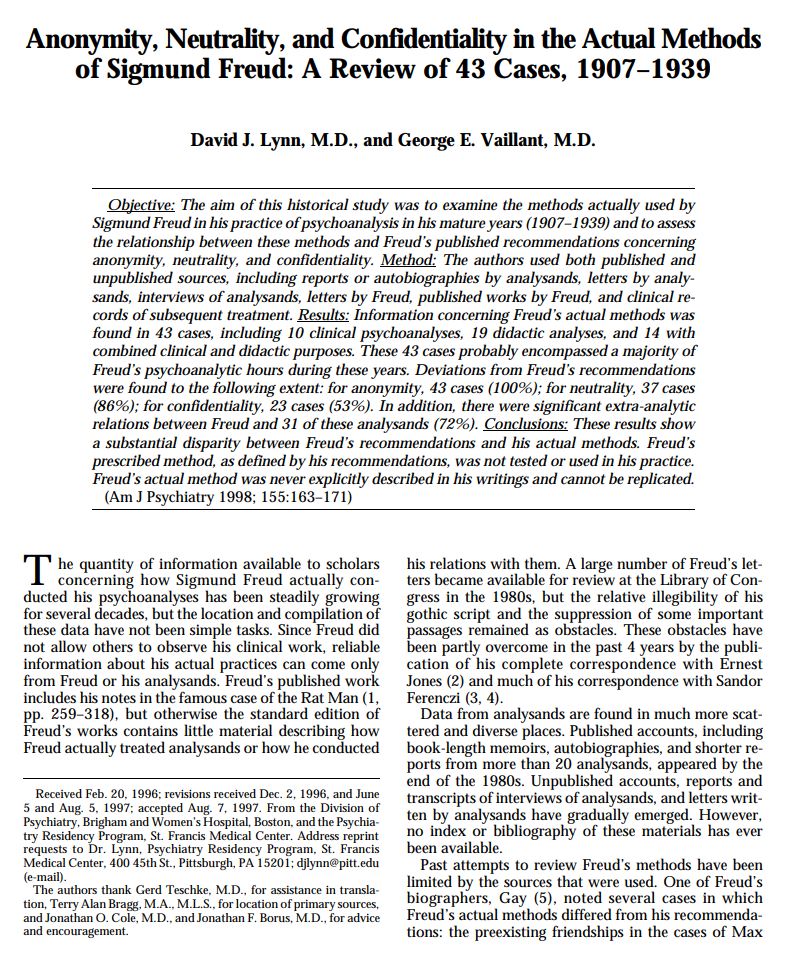
    Lynn, D. J., & Vaillant, G. E. (1998). Anonymity, neutrality, and confidentiality in the actual methods of Sigmund Freud: A review of 43 cases, 1907–1939. American Journal of Psychiatry, 155(2), 163–171.

  126. Books & chapters

    Magee, M., & Miller, D. C. (1997). Lesbian lives: Psychoanalytic narratives old and new. The Analytic Press.

  127. Books & chapters

    Mahler, M. S. (1988). The memoirs of Margaret S. Mahler (P. E. Stepansky, Ed.). Free Press.

  128. Books & chapters

    May, U. (2018). Freud at work: On the history of psychoanalytic theory and practice, with an analysis of Freud’s patient record books (D. Haller, B. Mathes, M. Molnar, P. Slotkin, & D. Winter, Trans.). Routledge. (Original work published 2015)

  129. Books & chapters

    May, U. (2018). Freud at work: On the history of psychoanalytic theory and practice, with an analysis of Freud’s patient record books (D. Haller, B. Mathes, M. Molnar, P. Slotkin, & D. Winter, Trans.). Routledge. (Original work published 2015)

  130. Institutional reports

    McLean, H. (1935). Chicago Psycho-Analytic Society. Bulletin of the International Psycho-Analytical Association, 16, 120.

  131. Journals & periodicals

    Meigs, K. E. (2017). When Harry met Jimmie: Trauma and ambition in Sullivan’s long-term domestic relationship. Psychoanalytic Perspectives, 14(1), 2–30.

  132. Books & chapters

    Menninger, K. A. (1995). The selected correspondence of Karl A. Menninger, 1919–1945 (H. J. Faulkner & V. D. Pruitt, Eds.). University of Missouri Press. (Original work published 1988)

  133. Books & chapters

    Menninger, K. A. (1995). The selected correspondence of Karl A. Menninger, 1919–1945 (H. J. Faulkner & V. D. Pruitt, Eds.). University of Missouri Press. (Original work published 1988)

  134. Books & chapters

    Millot, C. (2018). Life with Lacan (A. Brown, Trans.). Polity Press. (Original work published 2016)

  135. Journals & periodicals

    Monaco, N. (2025, November 11). The triangle of desire: Freud, Sidonie, and Lacan. European Journal of Psychoanalysis.

  136. Reference & web resources

    Mossop, H. (2025). Was Anna Freud a “friend of Dorothy”? A queer phenomenological historiography of Anna Freud and Dorothy Burlingham’s personal and professional relationship. British Journal of Psychotherapy, 41(1), 139–158.

  137. Reference & web resources

    Mossop, H. (2025). Was Anna Freud a “friend of Dorothy”? A queer phenomenological historiography of Anna Freud and Dorothy Burlingham’s personal and professional relationship. British Journal of Psychotherapy, 41(1), 139–158.

  138. Journals & periodicals

    Mossop, H., & Meadows, A. (2026). Queering the Freud Museum: Critical reflections on a museum tour about Anna Freud and Dorothy Burlingham’s life together at 20 Maresfield Gardens. Psychoanalysis and History, 28(1), 13–47.

  139. Journals & periodicals

    Mossop, H., & Meadows, A. (2026). Queering the Freud Museum: Critical reflections on a museum tour about Anna Freud and Dorothy Burlingham’s life together at 20 Maresfield Gardens. Psychoanalysis and History, 28(1). [Accepted manuscript].

  140. Reference & web resources

    Museum Haus C.G. Jung (n.d.). C.G. & Emma Jung-Rauschenbach. https://www.cgjunghaus.ch/en/museum/cg-emma-jung-rauschenbach/

  141. Books & chapters

    Naszkowska, K. (Ed.). (2024). Early women psychoanalysts: History, biography, and contemporary relevance. Routledge.

  142. Books & chapters

    Naszkowska, K. (Ed.). (2024). Early women psychoanalysts: History, biography, and contemporary relevance. Routledge.

  143. Reference & web resources

    National Register of Historic Places (n.d.). Alexander, Dr. Franz, Residence: Registration form.

  144. Books & chapters

    Nin, A. (1992). Incest: From “A journal of love”: The unexpurgated diary of Anaïs Nin, 1932–1934 (R. Pole, Ed.). Harcourt Brace Jovanovich.

  145. Reference & web resources

    Nölleke, B. (n.d.). Ada Müller-Braunschweig geb. Schott (1897–1959); Josine Müller geb. Ebsen (1884–1930). In Psychoanalytikerinnen: Biografisches Lexikon. https://www.psychoanalytikerinnen.de/deutschland_biografien.html

  146. Reference & web resources

    Nölleke, B. (n.d.-a). Hanna Fenichel geb. Heilborn (1897–1975). In Psychoanalytikerinnen: Biografisches Lexikon. https://www.psychoanalytikerinnen.de/deutschland_biografien.html

  147. Reference & web resources

    Nölleke, B. (n.d.-b). Hilda Abraham (1906–1971). In Psychoanalytikerinnen: Biografisches Lexikon. https://www.psychoanalytikerinnen.de/deutschland_biografien.html

  148. Reference & web resources

    Nölleke, B. (n.d.). Salomea Kempner; Hanna Fenichel; Frances Deri; Eva Landauer. In Psychoanalytikerinnen: Biografisches Lexikon. https://www.psychoanalytikerinnen.de/deutschland_biografien.html

  149. Books & chapters

    Paris, B. J. (1994). Karen Horney: A psychoanalyst’s search for self-understanding. Yale University Press.

  150. Books & chapters

    Paris, B. J. (1994). Karen Horney: A psychoanalyst’s search for self-understanding. Yale University Press.

  151. Reference & web resources

    Pawlicki, S. (2025, January 17). Frieda Fromm-Reichmann’s “Torah-peutic” psychoanalysis. National Park Service. https://www.nps.gov/articles/000/frieda-fromm-reichmann-cottage.htm

  152. Reference & web resources

    Pawlicki, S. (2025, January 17). Frieda Fromm-Reichmann’s “Torah-peutic” psychoanalysis. National Park Service. https://www.nps.gov/articles/000/frieda-fromm-reichmann-cottage.htm

  153. Journals & periodicals

    Pollock, G. H. (1977). The Chicago Institute for Psychoanalysis: From 1932 to the present. The Annual of Psychoanalysis, 5, 3–22.

  154. Journals & periodicals

    Pollock, G. H. (1983). The presence of the past. The Annual of Psychoanalysis, 11, 3–27.

  155. Books & chapters

    Quinn, S. (1987). A mind of her own: The life of Karen Horney. Summit Books.

  156. Books & chapters

    Quinn, S. (1987). A mind of her own: The life of Karen Horney. Summit Books.

  157. Books & chapters

    Reich, W., & Neill, A. S. (1981). Record of a friendship: The correspondence between Wilhelm Reich and A. S. Neill, 1936–1957 (B. R. Placzek, Ed.). Farrar, Straus and Giroux.

  158. Journals & periodicals

    Reports of proceedings of societies. (1934). Bulletin of the International Psycho-Analytical Association, 15, 525–534.

  159. Journals & periodicals

    Reports of proceedings of societies. (1934). Bulletin of the International Psycho-Analytical Association, 15, 525–534.

  160. Journals & periodicals

    Richebächer, S. (2016). “I long to get together with all of you …”: A letter of Sabina Spielrein-Scheftel (Rostov-on-Don) to Max Eitingon, 24 August 1927 (M. Molnar, Trans.). Psychoanalysis and History, 18(1), 119–133.

  161. Archives & interviews

    Riviere, J. (1953, Summer). Interview by K. R. Eissler [Interview transcript, tapes 14–15]. Sigmund Freud Papers, Interviews and Recollections, Set A (Box 121, Folder 8), Manuscript Division, Library of Congress, Washington, DC.

    View source
  162. Books & chapters

    Roazen, P. (1985). Helene Deutsch: A psychoanalyst’s life. Anchor Press/Doubleday.

  163. Books & chapters

    Rodman, F. R. (2003). Winnicott: Life and work. Perseus Publishing.

  164. Books & chapters

    Roudinesco, É. (1997). Jacques Lacan: Outline of a life, history of a system of thought (B. Bray, Trans.). Columbia University Press. (Original work published 1993)

  165. Journals & periodicals

    Rubin, J. B. (2024). A psychobiographical study of D. W. Winnicott. Clio’s Psyche, 31(2), 137–149.

  166. Books & chapters

    Rudnytsky, P. L. (2022). Mutual analysis: Ferenczi, Severn, and the origins of trauma theory. Routledge.

  167. Journals & periodicals

    Sandler, A.-M. (2004). Institutional responses to boundary violations: The case of Masud Khan. The International Journal of Psychoanalysis, 85(1), 27–42.

  168. Journals & periodicals

    Saul, L. J. (1939). Psychoanalytic case records. The Psychoanalytic Quarterly, 8(2), 186–190.

  169. Dissertations & theses

    Schechter, K. A. (2010). Illusions of a future: Psychoanalysis and the biopolitics of desire [Doctoral dissertation, University of Chicago].

  170. Journals & periodicals

    Schmidt, E. S. (2010). The Berlin tradition in Chicago: Franz Alexander and the Chicago Institute for Psychoanalysis. Psychoanalysis and History, 12(1), 69–83.

  171. Journals & periodicals

    Schröter, M., Mühlleitner, E., & May, U. (2004). Edith Jacobson: Forty years in Germany (1897–1938). The Annual of Psychoanalysis, 32, 199–215.

  172. Archives & interviews

    Severn, E. (1952, December 20). Interview by K. R. Eissler [Annotated interview transcript]. Sigmund Freud Papers, Interviews and Recollections, Set A (Box 122), Manuscript Division, Library of Congress, Washington, DC.

    View source
  173. Journals & periodicals

    Silver, A.-L. S. (2000). The 2000 Frieda Fromm-Reichmann lecture: The current relevance of Fromm-Reichmann’s works. Psychiatry, 63(4), 308–322.

  174. Journals & periodicals

    Sobolewska Alsberg, A. (2025). Psychoanalysis and biography in times of crisis: Freud’s late correspondence with Marie Bonaparte. The European Journal of Life Writing, 14, TC15–TC33.

  175. Journals & periodicals

    Sobolewska Alsberg, A. (2026a). Life for the future: Marie Bonaparte as a biographer. a/b: Auto/Biography Studies. Advance online publication.

  176. Journals & periodicals

    Sobolewska Alsberg, A. (2026b). The new trauma theory and the question of “truth” around 1932: The hidden history of revolutionary dyads in psychoanalysis. International Forum of Psychoanalysis. Advance online publication.

  177. Journals & periodicals

    Soreanu, R. (2019). Supervision for our times: Countertransference and the rich legacy of the Budapest School. The American Journal of Psychoanalysis, 79(3), 329–351.

  178. Books & chapters

    Strachey, J., & Strachey, A. (1985). Bloomsbury/Freud: The letters of James and Alix Strachey, 1924–1925 (P. Meisel & W. Kendrick, Eds.). Basic Books.

  179. Books & chapters

    Strachey, J., & Strachey, A. (1985). Bloomsbury/Freud: The letters of James and Alix Strachey, 1924–1925 (P. Meisel & W. Kendrick, Eds.). Basic Books.

  180. Books & chapters

    Strachey, J., & Strachey, A. (1985). Bloomsbury/Freud: The letters of James and Alix Strachey, 1924–1925 (P. Meisel & W. Kendrick, Eds.). Basic Books.

  181. Reference & web resources

    The Phillips Collection (n.d.). Chronology: Jacob Lawrence, The Migration Series. https://lawrencemigration.phillipscollection.org/artist/chronology

  182. Journals & periodicals

    Thomson, M. (2011). “The solution to his own enigma”: Connecting the life of Montague David Eder (1865–1936), socialist, psychoanalyst, Zionist and modern saint. Medical History, 55(1), 61–84.

  183. Journals & periodicals

    Time (1957). Expatriates: The travelers.

  184. Journals & periodicals

    Timms, E. (2013). Wilhelm Stekel’s dialogue with Sigmund Freud: The case for brief therapy and the symbolism of dreams. Psychoanalysis and History, 15(2), 207–220.

  185. Archives & interviews

    Van der Heide, C. (1963, May 21). Interview by Albert Kandelin [Interview transcript, RG-11.02]. New Center for Psychoanalysis, Los Angeles.

    View source
  186. Books & chapters

    Venier Alexander, I. (2026). The lost legacy of Franz Alexander. Karnac Books.

  187. Books & chapters

    Wake, N. (2011). Private practices: Harry Stack Sullivan, the science of homosexuality, and American liberalism. Rutgers University Press.

  188. Journals & periodicals

    Wake, N. (2017). Living with historical uncertainty. Psychoanalytic Perspectives, 14(1), 40–47.

  189. Journals & periodicals

    Warner, S. L. (1994). Freud’s analysis of Horace Frink, M.D.: A previously unexplained therapeutic disaster. Journal of the American Academy of Psychoanalysis, 22(1), 137–152.

  190. Books & chapters

    Weiss, E. (1991). Sigmund Freud as a consultant: Recollections of a pioneer in psychoanalysis. Transaction Publishers. (Original work published 1970).

  191. Books & chapters

    Weiss, E. (1991). Sigmund Freud as a consultant: Recollections of a pioneer in psychoanalysis. Transaction Publishers. (Original work published 1970).

  192. Journals & periodicals

    Welles, J., & Wrye, H. (1991). The maternal erotic countertransference. The International Journal of Psycho-Analysis, 72, 93–106.

  193. Reference & web resources

    Winnicott, C. (2013). The Cohen interviews: Clare Winnicott (née Britton), interview no. 24 (A. Cohen, interviewer; T. Cook & H. Marsh, Eds.). University of Warwick Modern Records Centre. (Interview conducted June 27, 1980)

  194. Books & chapters

    Wrye, H. K., & Welles, J. K. (1994). The narration of desire: Erotic transferences and countertransferences. The Analytic Press.

  195. Books & chapters

    Young-Bruehl, E. (1988). Anna Freud: A biography. Summit Books.

  196. Books & chapters

    Young-Bruehl, E. (2008). Anna Freud: A biography (2nd ed.). Yale University Press.

  197. Books & chapters

    Young-Bruehl, E., & Dunbar, C. (2009). One hundred years of psychoanalysis: A timeline, 1900–2000 [Foldout timeline]. Caversham Productions.

Edition: November 11, 2026 · 225 accounts through 1945 · 4 separately labeled later cases.

Top